A-B loop practice for guitar and language learning
Master complex guitar riffs or difficult language phrases by isolating specific video segments. Learn how SiftVid’s A-B loop feature turns passive watching into active practice.
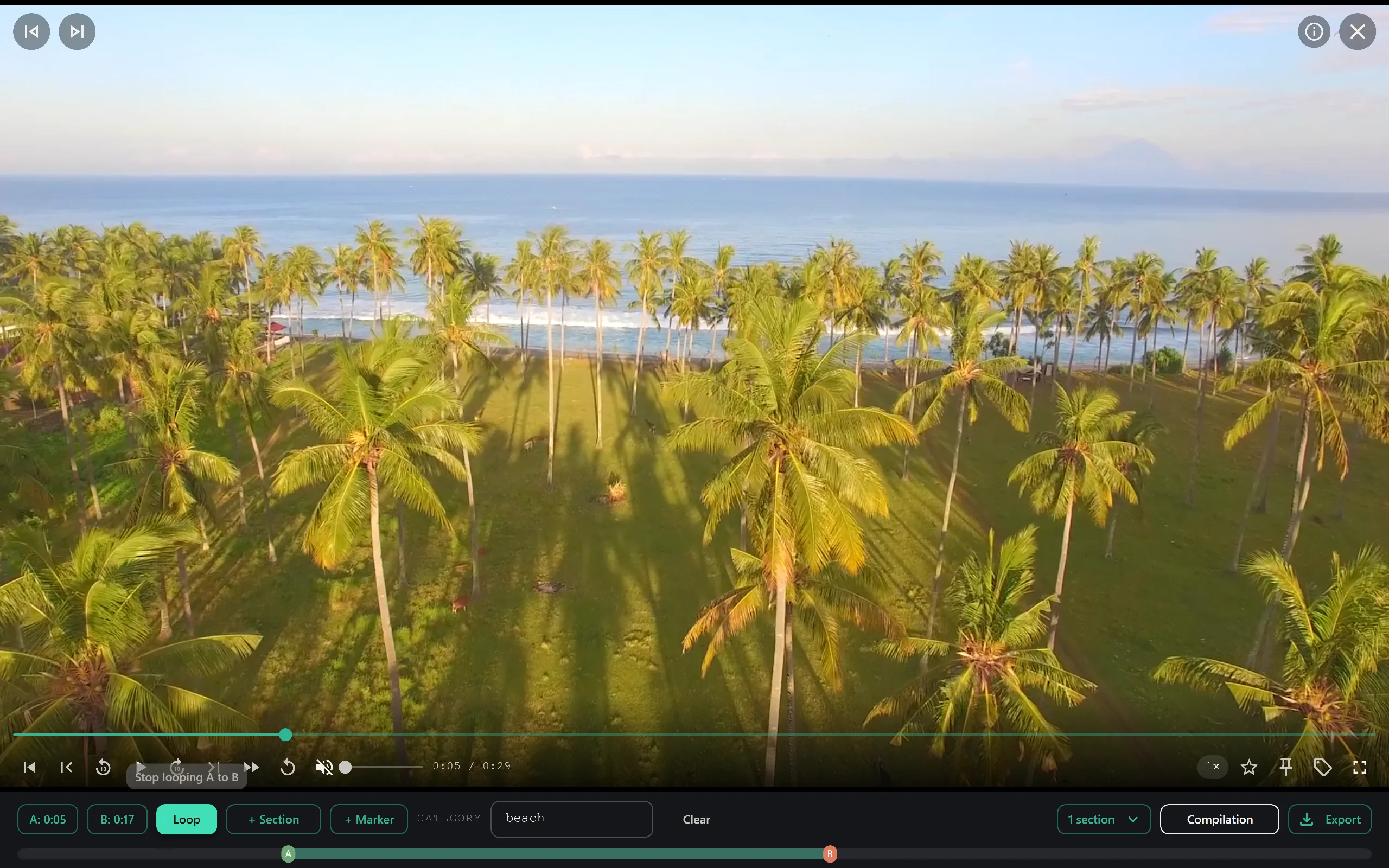
Learning a new skill from video is often a battle between frustration and boredom. You find a great tutorial on a complex jazz chord progression or a tricky French pronunciation, but the standard play button forces you to watch the entire video in linear time. If you miss a subtle finger placement or a distinct tonal shift, you must either rewind the whole video and hope you catch it again, or take notes that rarely capture the nuance of movement and sound. This is where A-B section loops transform passive consumption into active study.
An A-B loop allows you to select a start point (A) and an end point (B) and have the video play only that specific segment repeatedly. For guitarists, this means isolating the exact three seconds where a barre chord transition happens. For language learners, it lets you focus on a single sentence or idiom until the rhythm and intonation are memorized. Here is how to use this feature effectively to accelerate your learning curve.
Why Linear Playback Fails Skill Acquisition
Human motor skills and auditory processing require repetition. When you try to learn a guitar lick by watching a 10-minute video in real-time, your brain is overwhelmed with too much data. You cannot process the left-hand fingering, the right-hand picking, the tempo, and the theory simultaneously. By the time you reach the difficult part, the context is gone.
A-B looping solves this by removing context and focusing entirely on the mechanic. It allows for "chunking," a cognitive strategy where you break down a complex task into smaller, manageable pieces. You loop the difficult chunk, solve it, and then expand the window to include the previous or next chunk. This reduces cognitive load and prevents the frustration that often leads to quitting.
Isolating the "Ugly" Parts
In both music and language, the problems are usually specific. A guitarist might struggle with a 12th-bar turnaround. A language learner might trip over a complex verb conjugation in the middle of a dialogue.
When using A-B loops, your job is to hunt down these trouble spots. You do not need to master the entire piece at once. You only need to master the 5-second segment that is currently breaking your flow. By looping this segment, you can practice it at 100% speed until it feels effortless. Many users find that simply playing the loop 20 times in a row reveals small technical adjustments they missed when watching in real-time.
Setting Your Loop Points with Precision
The utility of an A-B loop depends entirely on the precision of your start and end points. If your A point is one frame too early, you include unnecessary context. If your B point is one frame too late, you lose the resolution of the final note or syllable.
In SiftVid, you can set these points with frame-level accuracy. This is critical for musical timing. A loop that cuts off the sustain of a guitar note or the tail of a word in a language lesson is technically incorrect. You want your loop to start exactly when the action begins and end exactly when it resolves. Take a minute to fine-tune these boundaries. It is a small investment of time that saves hours of confusing practice.
Building a Practice Session Routine
Once you have isolated a difficult segment, do not just loop it indefinitely. A structured routine yields better results. Here is a practical workflow:
- Identify: Watch the video linearly to identify the first difficult section.
- Isolate: Set the A and B points to cover just that section.
- Loop: Play the loop until you can perform the action or speak the phrase without thinking.
- Expand: Move the B point to include the next section. Loop the combined segment.
- Repeat: Continue this process until you can perform the entire passage without stopping.
This method prevents the "illusion of competence." Watching a video and nodding your head feels like learning, but only active, repeated engagement with the specific mechanic leads to retention. By forcing yourself to loop the segment, you are physically engaging with the material, not just observing it.
Applying This to Language Learning
For language learners, audio-linguistic drills are powerful. You can use A-B loops to practice "shadowing," where you repeat the audio as close to simultaneous as possible. Loop a 10-second clip of a native speaker. Listen once. Then loop it again, repeating the phrase in your head or out loud as the audio plays. Then loop it again, trying to speak it exactly as the audio plays.
You can also use this for listening comprehension. If a specific phrase is too fast, loop it and try to transcribe it. Does the speaker drop a vowel? Do they link two words together? The loop reveals these micro-details that are invisible at normal speed. This level of detail is essential for developing an ear for the language.
Applying This to Guitar Practice
For guitarists, the A-B loop is a metronome with visual context. You can loop a difficult chord change. Play it slowly. Then play it at normal tempo. If you stumble, the loop restarts, allowing you to try again immediately without losing your momentum.
You can also use loops to analyze technique. Set the loop to a very short segment, perhaps just two bars. Watch the instructor’s hand position. Is their thumb behind the neck? Is their wrist arched? The loop allows you to pause and inspect these details without the pressure of keeping up with the music. You can break down the movement into its component parts, such as the pick approach or the finger lift, and loop each one independently.
The Importance of Active Engagement
The most common mistake when using loops is passive watching. If you are just listening to the loop play over and over without physically performing the action or analyzing the technique, you are not learning. The loop is a tool for active engagement. You must be the one playing the guitar, speaking the language, or writing down the transcription.
Treat the loop as a coach. It never gets tired, never loses patience, and never rushes you. It provides immediate feedback by restarting the segment the moment you make a mistake. This rapid feedback loop is the core of muscle memory and language acquisition.
Conclusion
A-B section loops are a simple but powerful feature that turns video files into interactive study tools. By isolating specific segments, you can focus your energy on the parts of the skill that require the most attention. Whether you are wrestling with a difficult guitar riff or a complex language phrase, the ability to loop a specific section with frame-level precision can make the difference between frustration and mastery.
If you are ready to transform your video library from a passive archive into an active learning environment, you can explore the full list of features to see how A-B loops fit into a broader workflow. You can also visit the pricing page to start your 7-day free trial and test these techniques on your own videos. Remember, the goal is not just to watch more, but to practice better.
Keep reading
Offline video library for travel, RVs, and cabins
Build a local, offline video library for travel, RVs, and cabins. No cloud, no accounts. SiftVid keeps your media private and accessible anywhere.
Manage Real Estate Videography Footage Locally
Stop losing property shoots. Local-first tools help real estate videographers organize, tag, and export MP4/ProRes files securely and fast.